
Meeting Americans Where They Are: What the DOL's New AI Tool Gets Right
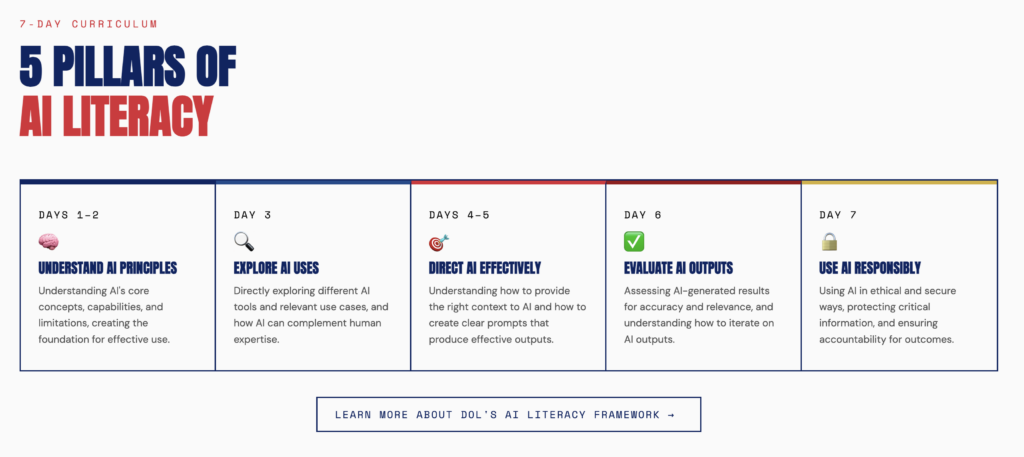
We talk a lot about the importance of upskilling. It is critical that we ensure people have the information they need to participate fully in an AI enabled economy. But there is a question that doesn’t get asked often enough. Not only do we need to determine which skills are important, but also how should upskilling be delivered to ensure it is accessible? A new tool from the Department of Labor is attempting to answer that question.
The DOL’s new text message-based AI literacy course is designed to reach Americans where they actually are. The premise is straightforward but also impactful. 98% of Americans have cell phones, and 91% have smart phones. That near-universal access makes text-based delivery one of the most democratically available channels we have for reaching workers across income levels, geographies, and circumstances.
Oftentimes, assumptions are baked into upskilling programs, e.g., that participants have reliable broadband access, a laptop, uninterrupted time, and the digital fluency to navigate an online learning platform. Those assumptions exclude a significant portion of the workforce before the first lesson even begins. Workers between shifts. Families without home internet. Mothers in rural communities. Workers juggling multiple jobs and family responsibilities who cannot spare two hours on a Tuesday evening, but can spend ten minutes on a break or while watching a kid’s game.
As the Department put it, the text-based design makes the course accessible “for busy Americans, who can still engage even with a few minutes between shifts or on their daily commute, and including for those without a laptop or with limited access to the internet.” As a result, this tool is doing what few other upskilling programs have effectively done before: it meets people where they are.
This user-focused design was also central to DOL’s AI Literacy Framework, released in February. For that framework, one of the delivery principles was to “Address Prerequisites to AI Literacy,” recognizing that for many workers, the barriers to AI literacy are not about motivation or capacity. Many face barriers that are practical or technical: digital literacy skills, device access, broadband connectivity, hours in the day. If it is to truly make a difference, effective workforce development has to address those prerequisites, not ignore them or pretend they aren’t legitimate barriers to upskilling.
At EqualAI, this alignment matters to us deeply. Our work on AI literacy is grounded in the belief that the gap between where people are and where they need to be in an AI-driven economy is real, urgent, and closeable, but only if the tools we build are designed for the full range of people who need them. A program that reaches the already-advantaged while leaving behind workers with the most at stake is not a workforce development success. It is a missed opportunity at best, and at worst, it compounds an opportunity gap that stands to worsen over time.
What the DOL has done here is model something important: accessibility is not an afterthought or a constraint on program design. It is the design. We need more of this thinking across both the public and private sectors if we intend to ready the workforce – and the country – to seize the opportunity AI offers. Building AI literacy at scale requires programs of all shapes and sizes, and above all, requires programs that are affordable, accessible, and designed to work within the constraints of everyday life.
Kudos to DOL on recognizing and addressing this need today. To give this a try or share with your community, text “READY” to 20202.
The Blogpost was also shared on Miriam’s Linkedin in March 2026. An original version of this article is available here.